Why Night Dive at All?
If you have only ever dived in daylight, you have seen half the reef. The underwater world operates on a 24-hour cycle, and the shift change happens at sunset. Diurnal fish retreat to crevices and sleep. Nocturnal predators emerge. Coral polyps extend their feeding tentacles. The entire colour palette shifts because the full spectrum of sunlight is gone, and what remains is filtered through your torch beam.
Night diving is not advanced diving in the technical sense. It does not require deeper depths or special certifications beyond the standard Night Diver specialty, which is optional, not mandatory. What it requires is comfort with your equipment, solid buoyancy control, and the mental discipline to stay calm when your field of vision is reduced to the cone of light in front of you. The reward is access to a reef that feels completely alien, even on a site you have dived a dozen times by day.
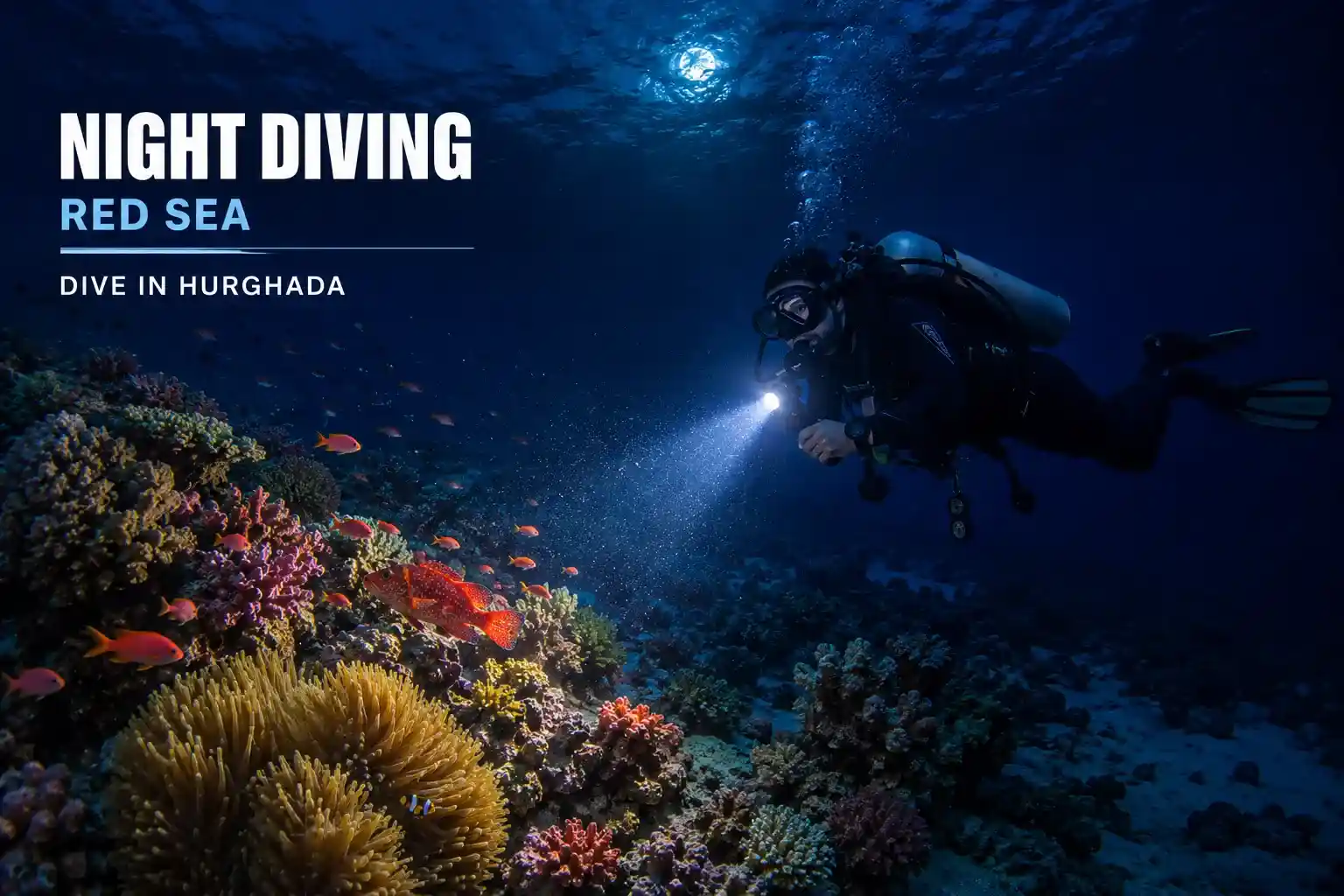
In the Red Sea, night diving has an additional advantage: the water is warm enough that even a long night dive in a 3mm wetsuit is comfortable year-round. Visibility at night is effectively infinite within your torch beam, and the lack of ambient light means colours appear more saturated than they do under the filtered blue of daylight. A red sponge that looks dull brown at 15 metres during the day glows crimson under torchlight at night.
What Changes After Dark
Colour Perception
Water absorbs light selectively. By 10 metres, red is gone. By 20 metres, orange and yellow have disappeared. At 30 metres, everything is blue or grey. This is why underwater photographers carry strobes, without artificial light, the spectrum is incomplete. At night, there is no ambient light at all. Your torch becomes the sun. Shine it on a coral wall and you see the full spectrum: reds, oranges, yellows, colours that do not exist in the daylight diver's experience. It is the closest most divers get to seeing the reef as it truly is.
Behavioural Shifts
Parrotfish, the loud grazers of the daytime reef, find crevices and secrete a mucus cocoon around themselves to mask their scent from predators. You can shine your torch into a crack and find a parrotfish suspended in a transparent bubble, eyes open, motionless. Moray eels, which hide during the day, emerge and hunt openly across the reef. Octopuses, masters of camouflage, become visible because they no longer need to hide, they are hunting. Crustaceans of every description, invisible during the day, parade across the reef in numbers that seem impossible.
Sensory Focus
Without peripheral vision, your attention narrows to what the torch illuminates. This is disorienting at first and meditative after the initial adjustment. You hear more: the crunch of parrotfish teeth on coral, the click of pistol shrimp, the snap of territorial damselfish. You feel more: the temperature gradient as you cross a thermocline, the current shift around a reef head. Night diving is less about seeing the whole reef and more about seeing what is directly in front of you with an intensity that daylight does not allow.
Marine Life at Night: The Shift Change
Predators on the Prowl
Lionfish, which hover in crevices during the day, emerge at night and hunt in the open. Their fins fan slowly, their striped bodies unmistakable in torchlight. They are not aggressive toward divers, but they are venomous, and their confidence at night means they are less likely to retreat from a diver's approach. Give them space. Moray eels hunt actively at night, sliding across the reef with their jaws open, testing the water for scent trails. Giant morays are particularly bold after dark, and encounters at close range are common.
The Invertebrate Parade
Crustaceans dominate the night reef. Hermit crabs, too small to notice during the day, march in columns across sand patches. Decorator crabs, camouflaged with algae and sponge fragments, are easier to spot at night because they move. Spiny lobsters emerge from their caves and walk the reef in pairs, antennae sweeping ahead like radar. Coral shrimp, invisible in daylight, gather on coral heads in groups of ten or twenty, cleaning stations that operate 24 hours but are only visible at night.
Coral Feeding
Hard corals are animals, not plants, and they feed at night. Each polyp extends tiny tentacles to capture plankton from the water column. Under torchlight, a coral head looks like a field of flowers in a breeze, thousands of tentacles waving in the current. Soft corals pulse and sway more actively at night, feeding on the same plankton. The reef is not sleeping. It is eating.
Hunting Octopuses
Octopuses are primarily nocturnal hunters. During the day they are camouflage experts, indistinguishable from rock. At night they move, changing colour and texture as they cross the reef, probing crevices for crabs and small fish. A night dive without an octopus sighting in the Red Sea is unusual. They are curious animals, and a diver who remains still may find an octopus approaching to investigate the torch beam. The interaction is one of the most memorable in diving.
| Creature | Daytime Behaviour | Nighttime Behaviour |
|---|---|---|
| Parrotfish | Active grazing, loud, visible | Sleeps in mucus cocoon inside crevice |
| Moray Eels | Hides in holes, head visible | Hunts openly across reef |
| Octopus | Camouflaged, motionless | Active hunting, curious of divers |
| Lionfish | Hovers in crevices, defensive | Hunts in open water, confident |
| Crustaceans | Hidden, mostly invisible | Active everywhere on reef |
| Coral Polyps | Retracted, photosynthesising | Extended, feeding on plankton |
Equipment: What You Actually Need
Primary Torch
Your primary torch is your most important piece of night diving equipment. It needs to be bright enough to illuminate the reef at arm's length, reliable enough to not fail mid-dive, and comfortable enough to hold for an hour. LED torches with 1000–2000 lumens are the standard. Narrow beam angles are better for signalling and penetration; wide angles are better for photography and general illumination. Most experienced night divers carry a torch with adjustable focus.
Battery life is critical. A torch that dies at 25 minutes turns a night dive into an emergency. Test your battery before every night dive, and carry a fresh set even if the current set is not empty. In Hurghada, we see divers every month who assumed their battery was fine because it worked on the last dive. Night diving is not the place for assumptions.
Backup Torch
A backup torch is not optional. It lives in your BCD pocket, charged and tested, and it comes out if your primary fails. It does not need to be as bright as your primary, 500 lumens is sufficient for a safe ascent and surface swim. The rule is simple: if you do not have a backup torch, you do not do a night dive. No exceptions.
Chemical Light (Glow Stick)
A chemical light stick or battery-powered marker attached to your tank valve makes you visible to your buddy and the dive guide from behind. In the Red Sea, where night dives often have 4–6 divers, this is essential for group cohesion. Without it, you are a disembodied torch beam in the dark, and your buddy has no reference for your position.
What You Do Not Need
You do not need a bigger tank. Night dives are typically shorter than day dives, 45–50 minutes is standard. You do not need a different BCD or regulator. You do not need a knife or cutting tool unless you are penetrating wrecks, which is not standard on recreational night dives. Keep it simple. The more familiar your kit, the more attention you can devote to the dive.
Safety Procedures: The Rules That Matter
Pre-Dive Briefing
The night dive briefing covers more than the day briefing. Entry and exit points are discussed in detail because navigation is harder in the dark. The torch signal system is reviewed: circular motion means OK, rapid side-to-side motion means emergency. The maximum depth and dive time are set, usually 18 metres and 50 minutes for recreational night dives. The buddy system is emphasised more strictly than in daylight, losing your buddy at night is a serious problem.
Entry and Exit
Most Red Sea night dives are boat dives. The boat remains anchored at the site with its lights on, providing a reference point throughout the dive. Entry is a giant stride or backward roll with torch in hand, switched on before you hit the water. Exit is a controlled ascent up the mooring line or a free ascent with the boat lights as reference. Surface swims in the dark are disorienting and should be avoided. If you surface away from the boat, shine your torch upward and wait. The boat crew is watching for lights.
Torch Discipline
Shining your torch directly into another diver's eyes destroys their night vision for several minutes. It is the underwater equivalent of flashing a camera in someone's face in a dark room. When signalling to a buddy, direct the beam at your own chest or hand, not their mask. When observing marine life, avoid prolonged direct illumination, it stresses the animal. Move the beam slowly and predictably. Sudden movements startle fish and waste battery.
Buoyancy Control
Buoyancy control at night is more critical than in daylight. Without visual reference to the surface or the bottom, depth creep is common. Divers descend without realising it because their only reference is the torch beam, which illuminates a small area. Check your computer frequently. Maintain neutral buoyancy and avoid contact with the reef, you cannot see what you are about to touch outside the beam.
Emergency Procedures
If your primary torch fails, signal your buddy with hand movements in their beam, switch to your backup, and begin a controlled ascent. If both torches fail, which is extremely rare but possible, hold your buddy's tank valve and follow them up. If separated from the group, ascend slowly to 5 metres, look for the boat lights or other torch beams, and signal with your backup torch. Do not swim off in a random direction hoping to find the group. The ocean is big and dark.
Your First Night Dive: What to Expect
The Descent
The first 30 seconds of a night dive are the most disorienting. You are in the water, it is dark, and your torch beam cuts a narrow cone through black water. There is no reference, no horizon, no surface visible above. The instinct is to panic, to grab for the mooring line, to shine the torch in every direction at once. The correct response is to stop, breathe, and let your eyes adjust. Within a minute, the beam stabilises, your breathing slows, and the reef appears below you, more vivid than you expected.
The First Ten Minutes
The first ten minutes are about adjustment. Your brain is recalibrating to a world without peripheral vision. You will check your depth more often than usual. You will feel for your buddy's presence more frequently. This is normal. By the fifteen-minute mark, most divers have settled into a rhythm. The torch beam becomes an extension of your attention, not a limitation. You start to notice what is outside the beam: the bioluminescence when you move your hand, the eyes of shrimp reflecting red, the faint glow of phosphorescent coral.
The Return
Ascending at night is different from descending. You are lighter, more positively buoyant, and the surface is a dark void above you. The boat lights, usually white or green, are your target. As you approach the surface, slow down. Check above you with your torch to ensure no one is descending into your path. Surface near the boat, signal OK, and hand up your torch before removing your gear. The dive is over, but the memory of what you saw will last longer than any day dive.
Best Night Dive Sites Around Hurghada
Abu Ramada (The Aquarium)
Abu Ramada is known as the Aquarium for a reason. The shallow reef, 5–15 metres, is densely packed with coral and marine life. At night, the site transforms. Parrotfish sleep in crevices, moray eels hunt across the sand, and octopuses are almost guaranteed. The shallow depth means a long dive time, and the protected location means calm conditions on most nights. This is the standard first night dive for Open Water students in Hurghada.
Giftun Island (Sheltered Bay)
The sheltered bay on the leeward side of Giftun Island offers a sandy bottom with scattered coral heads, ideal for spotting hunting octopuses and free-swimming morays. The bay is protected from current and wind, which makes it predictable for night diving. Lionfish are common here, and the occasional hunting barracuda passes through. The depth is 8–12 metres, making it accessible for all levels.
Abu Nuhas Wrecks (Giannis D)
For Advanced divers, the Giannis D wreck at night is an entirely different experience from the day dive. The structure is familiar, but the atmosphere is not. Torchlight inside the holds reveals glassfish in densities that seem to multiply after dark. The penetration routes that are obvious in daylight require more attention at night, and the experience is not recommended for divers without wreck penetration experience and a guide who knows the site intimately.
| Site | Depth | Level | Night Highlights |
|---|---|---|---|
| Abu Ramada | 5–15m | Open Water | Parrotfish sleep, octopus, morays |
| Giftun Island Bay | 8–12m | Open Water | Lionfish, octopus, hunting barracuda |
| Abu Nuhas (Giannis D) | 10–28m | Advanced | Wreck penetration, glassfish, atmosphere |
| Carless Reef | 15–25m | Advanced | Pelagic hunters, shark encounters possible |
Night Underwater Photography
Night photography is simpler than daylight photography in some ways and more demanding in others. The light is entirely under your control, which means no competing ambient light to balance against your strobes. The downside is that every shot requires artificial illumination, and the narrow beam of a torch does not substitute for a proper strobe or video light.
A single strobe is sufficient for most night photography. Position it to the side of the lens to avoid backscatter from particles in the water column. The closer the strobe to the lens axis, the more backscatter you will get. Reducing strobe power and moving closer to the subject produces better results than full power from a distance. Macro photography at night is particularly rewarding: coral polyps, shrimp eyes, and nudibranchs glow under controlled light in ways that daylight cannot replicate.
The golden rule of night photography is the same as the golden rule of night diving: never touch the reef for stability. If your buoyancy is not solid enough to hold position while operating a camera, you are not ready to photograph that subject. A broken coral polyp takes months to recover. A missed photograph takes a second to forget.
Bioluminescence: The Light You Cannot Photograph
Bioluminescence in the Red Sea is not as dramatic as in some other oceans, but it is present. Dinoflagellates, microscopic planktonic organisms, emit light when disturbed. Wave your hand through the water in total darkness and you will see a trail of blue sparks. Kick your fins and the wake glows. It is faint, ephemeral, and impossible to capture with standard underwater cameras because the light is too weak for sensors.
The best way to see bioluminescence is to turn off your torch at the safety stop, 5 metres, and let your eyes adjust for 30 seconds. Move your hand slowly through the water. The effect is subtle but real, and it is one of the few underwater experiences that cannot be shared through photography. You have to be there. This is part of what makes night diving irreplaceable.
Frequently Asked Questions
Do I need a special certification to night dive?
No. The PADI Night Diver specialty is recommended but not mandatory for guided night dives. Most dive centres in Hurghada will take any Open Water certified diver on a guided night dive after a briefing. The specialty course adds navigation skills, communication protocols, and emergency procedures that make you a more competent night diver, but it is not a prerequisite for your first experience.
Is night diving dangerous?
It carries additional risks compared to day diving, primarily related to limited visibility and disorientation. These risks are manageable with proper equipment, a thorough briefing, and adherence to standard procedures. The accident rate for night diving is not significantly higher than day diving when divers follow the protocols. The most common problem is buddy separation, which is why the tank marker and torch discipline matter.
What if I am afraid of the dark?
This is the most common concern among divers considering their first night dive. The darkness underwater is not like darkness on land. You have a torch, you have a buddy, you have a dive guide, and you have a boat with lights on the surface. The fear usually dissipates within the first five minutes of the dive, replaced by fascination. If you are genuinely anxious, start with a dusk dive, entering before sunset and surfacing after dark. The transition is gentler.
How long is a typical night dive?
45–50 minutes is standard for recreational night dives. Shallow sites allow longer dives, but most operators keep night dives to a single tank to manage logistics and safety. The last thing a dive centre wants is a group surfacing at 10pm because someone pushed their air supply to the limit.
Can I night dive as a beginner?
Yes, if you are comfortable with your basic skills. We have taken Open Water students on their first night dive on the final day of the course. The key is confidence in buoyancy, mask clearing, and regulator recovery. If you are still struggling with these skills in daylight, add a few more day dives before attempting night diving. There is no rush. The reef will still be there next week.
What marine life can I expect to see?
Octopus, moray eels, lionfish, parrotfish sleeping in crevices, crustaceans of every description, coral polyps feeding, and hunting behaviour that is rare in daylight. What you will not see are the schooling reef fish that dominate daytime dives. They are asleep. The night reef is a different ecosystem, not a diminished one.
Ready to See the Reef After Dark?
Night diving is not for everyone, but it is for more divers than think it is. The fear is almost always worse than the reality, and the reality is extraordinary. The Red Sea, with its warm water, clear conditions, and abundant nocturnal marine life, is one of the best places in the world to try your first night dive. We run night dives from Hurghada several times a week, usually as the second dive of an afternoon trip or as a dedicated evening excursion. Get in touch and we will make sure your first night dive is on a site that matches your experience level.