Why the Red Sea Is Biologically Unique
The Red Sea is one of the youngest seas on Earth, geologically speaking, and one of the most isolated. Connected to the Indian Ocean only through the narrow Bab-el-Mandeb strait, it has evolved a marine ecosystem with a rate of endemism approaching 20%. That means one in five species you see here exists nowhere else on the planet.
The water is warm year-round (22–29°C), highly saline due to minimal freshwater input, and extraordinarily clear. Visibility of 30 metres is normal, 40 metres is common. This clarity is not just pleasant for divers, it shapes the entire ecosystem. Light penetrates deeper, coral grows at unusual depths, and the visual hunting strategies of predators have evolved accordingly.
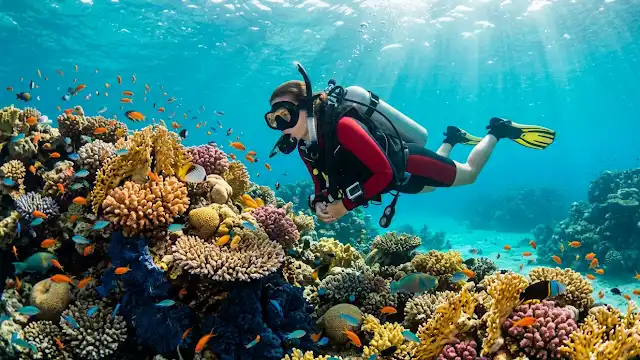
For divers based in Hurghada, this translates to a single day trip where you can see ten distinct fish families, three coral structures, and possibly a turtle or reef shark. The density of life is not accidental. It is the product of stable conditions, protected areas like the Giftun Island National Park, and a local diving culture that has learned, slowly, that conservation is good business.
Reef Fish: The Constant Motion
Reef fish are the background music of every Red Sea dive. They are everywhere, in schools and pairs and solitary patrols, and learning to identify the major families transforms a pleasant dive into an engaged one. Here are the families you will encounter on almost every dive out of Hurghada.
Butterflyfish (Chaetodontidae)
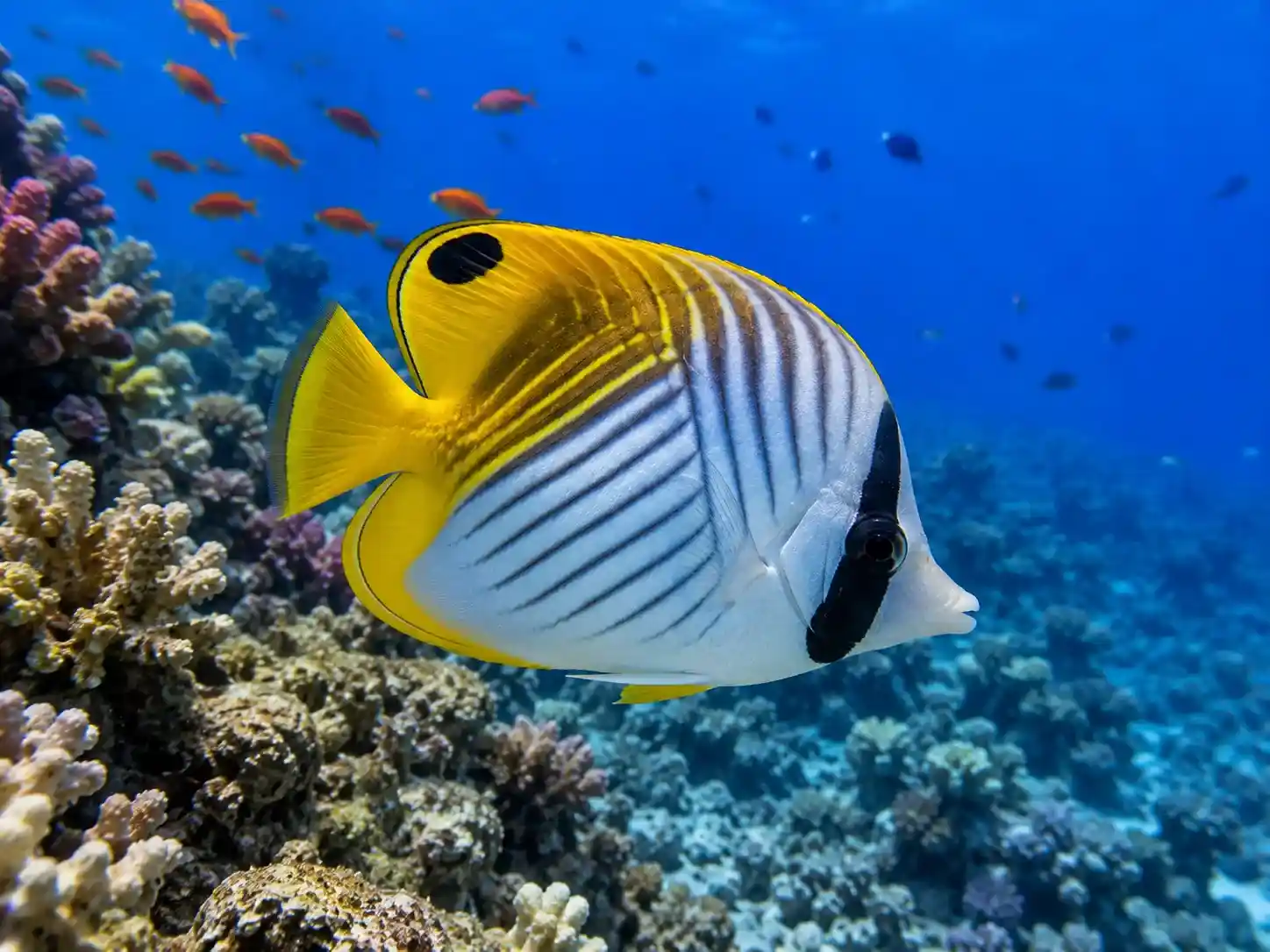
Disc-shaped, laterally compressed, and almost always in pairs. The Red Sea raccoon butterflyfish wears a black mask across its eyes. The longnose butterflyfish probes crevices with a snout that seems disproportionate to its body. They feed on coral polyps and are territorial around their chosen coral heads. If you see a pair hovering near the same coral on multiple dives, it is likely the same pair defending their feeding ground.
Angelfish (Pomacanthidae)
Larger and more deliberate than butterflyfish, angelfish patrol reef walls with the confidence of animals that know they are too big for most predators. The emperor angelfish, with its electric blue and yellow stripes, is the most photographed fish in the Red Sea. Juveniles look completely different, a dark blue body with concentric white circles, and the transition between juvenile and adult colouration is one of the most dramatic in marine biology.
Surgeonfish & Tangs (Acanthuridae)
The sohal surgeonfish is endemic to the Red Sea and one of the most aggressive fish you will encounter. It grazes algae from reef rock and will charge divers who venture too close to its territory. The scalpel-like spine on each side of the tail base gives the family its name. It is sharp enough to cut skin, and the fish uses it in territorial disputes. Watch for the blue tang schools that move across reef crests like living clouds.
Wrasses & Parrotfish (Labridae & Scaridae)
Wrasses are the cleaners of the reef. Cleaner wrasses operate stations where larger fish queue to have parasites removed from their mouths and gills. The interaction is mutualistic and precise, the wrasse gets food, the client gets hygiene. Parrotfish are larger, more robust, and responsible for a significant portion of the sand on Red Sea beaches. They graze algae from coral using beak-like teeth fused into a solid plate, and the coral they digest passes through as fine sand. A single parrotfish can produce hundreds of kilograms of sand per year.
Anthias & Basslets (Serranidae)
The pink and orange anthias that hover in the current above reef tops are the most numerous fish in the Red Sea. They are planktivores, feeding on passing particles, and their schooling behaviour is a defence against predators. When a diver approaches, the school parts and reforms, a behaviour that is both beautiful and mathematically fascinating. At Abu Nuhas wrecks, anthias schools are so dense they obscure the wreck structure behind them.
Groupers (Serranidae)
The peacock grouper, with its mottled red and blue pattern, is common around Hurghada's reefs. Larger groupers, the potato cod and giant grouper, are less common but present. They are ambush predators, resting motionless in crevices until prey passes close enough. Groupers are also known for cooperative hunting with moray eels, one of the few documented interspecies hunting partnerships in the marine world.
| Family | Common Species | Behaviour | Best Depth |
|---|---|---|---|
| Butterflyfish | Raccoon, Longnose, Red Sea Chevron | Paired, territorial around coral | 5–20m |
| Angelfish | Emperor, Regal, Yellowbar | Solitary patrollers, territorial | 5–25m |
| Surgeonfish | Sohal, Palette, Unicorn | Schooling or solitary grazers | 3–30m |
| Parrotfish | Bicolour, Rusty, Dusky | Grazing, sand production | 3–20m |
| Anthias | Lyretail, Red Sea Anthias | Hovering schools in current | 5–30m |
| Groupers | Peacock, Coral Hind, Potato Cod | Ambush predators in crevices | 10–40m |
Pelagics & Large Species: The Hunt for the Unexpected
Pelagic species live in open water, not on the reef, and their appearances are unpredictable. This is what makes them exciting. You can dive the same site fifty times and see nothing but reef fish, then on the fifty-first dive, a manta ray passes overhead.
Reef Sharks
Grey reef sharks are the most commonly encountered shark in the Hurghada area. They patrol reef walls and drop-offs, usually at 20–30 metres, and are shy around divers. Oceanic whitetip sharks are larger, more curious, and occasionally approach divers on open water ascents. Neither species is aggressive toward humans. The shark population in the Red Sea has declined significantly over the past two decades due to overfishing outside protected areas, which makes every encounter meaningful.
Rays
Eagle rays glide over sandy bottoms, flapping their wings in slow, hypnotic motion. They feed on molluscs buried in the sand, and their approach is to detect prey through electroreception. The spotted eagle ray, with its white dorsal spots, is the most visually striking. Stingrays bury themselves in sand in shallow areas, visible only by their eyes and tail spine. Step carefully in sandy lagoons.
Barracuda & Trevally
Schooling barracuda form silver tornadoes that spiral around divers before reforming into tight balls. They are not dangerous to divers despite their reputation, the attacks on humans attributed to barracuda are almost always cases of mistaken identity in murky water. Giant trevally (GT) are the apex predators of the reef. They hunt in packs, herding smaller fish against the reef wall, and their strikes are explosive enough to be audible underwater.
Whale Sharks & Mantas
Whale sharks visit the Red Sea during summer plankton blooms, particularly around offshore islands and in the southern Red Sea. They are filter feeders, the largest fish on Earth, and completely harmless. Reef mantas are less common in the northern Red Sea but appear at cleaning stations around Elphinstone and Brothers Islands. If you are diving in Hurghada and hear a dive guide shout into their regulator, it is usually because something large has appeared on the blue horizon.
Macro Life: The Small World That Rewards Patience
Not every remarkable creature is large. The Red Sea macro life is as diverse as its pelagics, and finding it requires a different approach: slow movement, close focus, and the willingness to spend ten minutes examining a single coral head.
Nudibranchs (Sea Slugs)
Nudibranchs are gastropod molluscs that have lost their shells and evolved elaborate colouration as chemical defence. The chromodoris nudibranchs of the Red Sea are electric blue with orange margins, the hypselodoris species are purple and yellow. They crawl slowly across coral and rock, leaving curly egg ribbons behind them. A single dive site can host ten species if you know where to look.
Moray Eels
Giant morays, honeycomb morays, and yellow-mouthed morays are common in Hurghada. They rest in crevices with their mouths open, not as aggression but as respiration. Morays have poor eyesight and rely on smell. They are not dangerous unless provoked or fed, and the giant moray's partnership with groupers is one of the most studied cooperative hunting behaviours in the ocean.
Lionfish & Scorpionfish
The lionfish is an invasive species in the Caribbean but native to the Red Sea. Their venomous dorsal spines are a defence, not a hunting tool, and their slow, fanning movement is hypnotic to watch. Scorpionfish and stonefish are masters of camouflage, resting on the reef in perfect imitation of rock and coral. Their venom is delivered through dorsal spines and is extremely painful. The rule is simple: look carefully before you touch anything, and never touch the reef anyway.
Octopus & Cuttlefish
Octopuses are present on almost every reef but rarely seen because they are camouflage experts. They change colour and texture in milliseconds, and their problem-solving intelligence is well documented. Cuttlefish are more visible, often hovering in open water, and their ability to produce pulsing waves of colour across their bodies is used for communication and hunting hypnosis.
Crustaceans & Cleaning Stations
Cleaner shrimp wave their white antennae to signal their services to passing fish. Hermit crabs occupy discarded shells and scuttle across the reef floor. Pistol shrimp snap their claws fast enough to create cavitation bubbles that stun prey. These small dramas play out constantly, and the diver who moves slowly enough to observe them gains a second layer of enjoyment from every dive.
Turtles & Marine Mammals
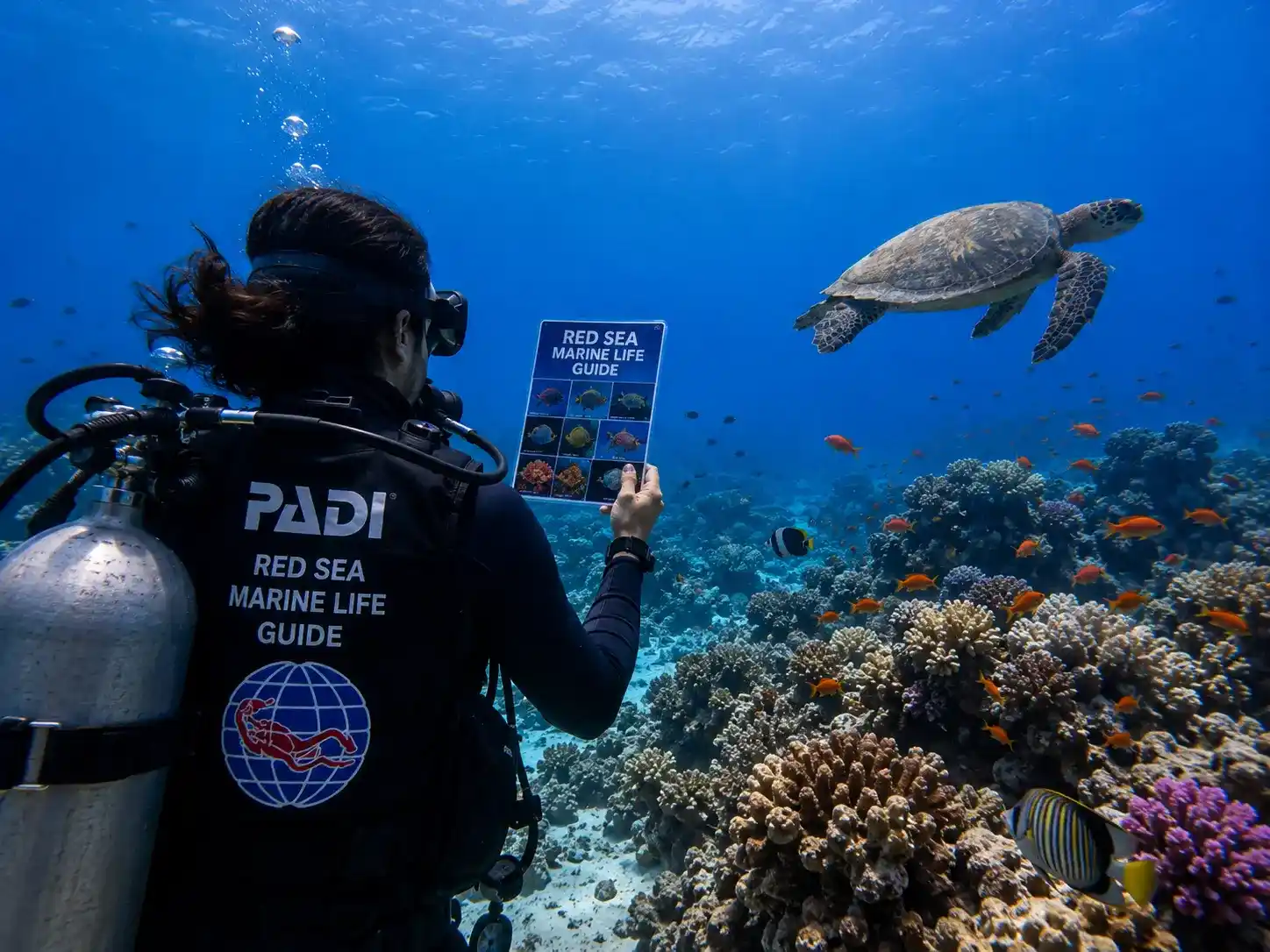
Two turtle species are regularly encountered in the Hurghada area: the green turtle and the hawksbill turtle. Green turtles are larger, up to a metre in length, and feed primarily on seagrass. They are often seen grazing in shallow meadows or sleeping under coral ledges. Hawksbills are smaller, with a distinctive hooked beak adapted for extracting sponges from reef crevices. They are critically endangered, and every sighting is significant.
Turtles surface to breathe every five to ten minutes. If you are diving and a turtle passes below you, resist the urge to chase it. They are faster swimmers than humans, and pursuit stresses them. The best encounters happen when you remain still and allow the turtle to approach on its own terms.
Dolphins, primarily spinner dolphins and bottlenose, are occasionally seen from dive boats. They rarely interact with divers underwater in the Hurghada area, though they are known to bow-ride vessels. Dugongs, the marine mammals that inspired mermaid legends, are present in the southern Red Sea but extremely rare in the Hurghada region. A dugong sighting is a once-in-a-lifetime event.
Coral Reef Foundations: The Architecture of the Underwater World
The Red Sea contains approximately 250 species of coral, a mix of hard corals that build reef structure and soft corals that add colour and movement. Understanding the difference changes how you see the reef.
Hard Corals (Scleractinia)
Hard corals are the builders. They secrete calcium carbonate skeletons that accumulate over centuries into reef structures. Brain coral forms bumpy, hemispherical colonies that can live for hundreds of years. Table coral grows as flat, circular platforms that provide shelter for fish underneath. Staghorn coral branches like antlers and is one of the fastest-growing coral types, capable of recovering from bleaching events more quickly than slower-growing species.
Coral bleaching is the greatest threat to Red Sea reefs. When water temperatures rise above 30°C for extended periods, corals expel the symbiotic algae that provide their colour and nutrition. The coral turns white, and if conditions do not improve, it dies. The Red Sea has shown more resilience than other regions due to its native coral genotypes, but the threat is real and accelerating.
Soft Corals (Alcyonacea)
Soft corals do not build rigid skeletons. They are flexible, often tree-like or whip-like, and sway in the current. Gorgonians (sea fans and sea whips) are the most visually striking, growing in perpendicular orientations to the current to maximise plankton capture. The Red Sea is famous for its purple and yellow soft coral coverage on walls and overhangs, particularly at sites like Abu Ramada and the Giftun Islands.
Fire Coral & Hydroids
Fire coral is not a true coral but a colonial hydrozoan. It looks like coral, grows like coral, and stings like a jellyfish. Contact produces a burning rash that can last for days. It is common on mooring lines and reef edges, and the standard advice is to wear gloves when handling lines and maintain neutral buoyancy to avoid accidental contact.
Where to See What: Site-Specific Marine Life
Not all sites are equal. The marine life you encounter depends on depth, current, substrate, and time of day. Here is what to expect at the major Hurghada sites.
| Dive Site | Depth Range | Key Species | Best For |
|---|---|---|---|
| Giftun Island | 5–25m | Turtles, anthias, parrotfish, eagle rays | Beginners, photography |
| Abu Ramada | 10–30m | Morays, lionfish, soft corals, barracuda | Reef diversity, macro |
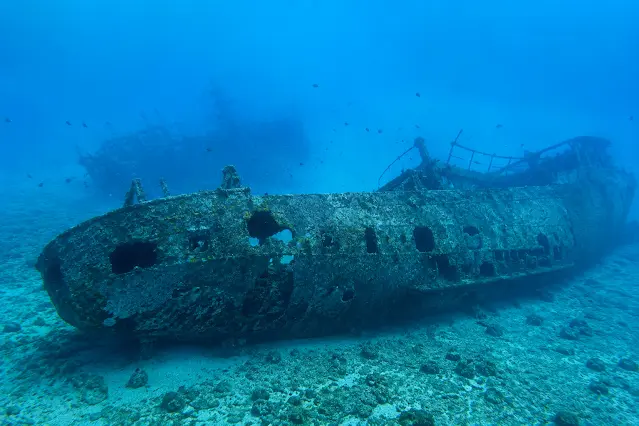
| Abu Nuhas Wrecks | 10–30m | Glassfish, batfish, scorpionfish, groupers | Wreck ecology, penetration |
| Carless Reef | 15–40m | Grey reef sharks, tuna, large groupers | Pelagics, advanced divers |
| Sha'ab El Erg | 5–20m | Dolphins, turtles, stingrays | Shallow diving, snorkelling |
| Umm Gamar | 10–35m | Napoleon wrasse, eagle rays, octopus | Wall diving, macro |
Seasonal variations matter. Summer (June–September) brings whale sharks and manta rays to offshore sites. Winter (December–March) offers the clearest visibility and the most active shark populations. Spring and autumn are the most consistent for overall marine life activity.
Underwater Photography in the Red Sea
The Red Sea is one of the most forgiving environments for underwater photography. The visibility, the colour saturation, and the density of subjects mean that even photographers with basic equipment can produce memorable images. The challenge is not finding subjects, it is managing your buoyancy while operating a camera.
Wide-angle lenses work best for reef scenes, schooling fish, and large pelagics. The clear water means you can shoot natural light at shallow depths, though a strobe or video light is essential for restoring colour below 10 metres. Macro photography requires patience and a steady hand. Nudibranchs, shrimp, and small crustaceans are perfect subjects, but they demand close focus and minimal disturbance.
The golden rule: never touch the reef for stability. If you cannot hold position with your buoyancy skills alone, you are not ready to photograph that subject. A broken coral formation takes decades to recover. A missed photograph takes a second to forget.
Conservation & Responsible Diving
The Red Sea marine life is not infinite. The pressures are familiar: climate change, overfishing, coastal development, and careless diving. The last factor is the only one you control directly.
Every diver has a responsibility to minimise their impact. This means perfect buoyancy to avoid contact with coral, reef-safe sunscreen (oxybenzone and octinoxate kill coral polyps at concentrations measured in parts per billion), and refusal to participate in fish feeding or harassment. The lionfish feeding shows that some operators run are not conservation, they are entertainment that distorts natural behaviour.
We support local marine protected areas and contribute to reef monitoring programmes. The Giftun Island National Park, established in 1995, is one of the success stories. Fishing is restricted, mooring buoys prevent anchor damage, and the result is a reef system that looks much as it did twenty years ago. Other areas without protection have declined noticeably. The difference is policy, and policy follows public pressure.
Ready to See It for Yourself?
Reading about marine life is preparation. Seeing it is transformation. The first time a turtle swims past you without concern, the first time you identify a species you read about the night before, the first time you understand that you are a visitor in a world that does not need you, those are the moments that define diving.
We run daily trips to the sites mentioned in this guide. Whether you are a beginner looking for your first reef encounter or an experienced diver chasing a specific species, we can put you in the right place at the right time. Get in touch and tell us what you want to see.